Wednesday, April 10, 2013

Wings by Aprilynne Pike

 
Genre: Fantasy
Rating: *** (liked it)
Pages: 290
Series: First of a trilogy
Laurel always knew she was different. She was left on her parents' doorstep at age four, homeschooled for eleven years, and she's a ridiculously light eater. And then a flower started growing out of her back.
With the help of her (only) friend, the geeky David, and a mysterious boy named Tamani, Laurel discovers she's a faerie. She was sent from the Avalon to the human world to save it from a troll invasion. And if that wasn't bad enough, the trolls know where she lives.
David's nothing like typical love interests. He's nice but nerdy, the kind of guy you can actually imagine running into at high school. And what's more, he actually likes Laurel. He doesn't ignore her while she lusts after him. He's not infatuated with her. It's a bonafide, genuine crush.
"Whatever you need, I'll be. If you need the science geek to give you answers from a textbook, I'm your guy; if you just want a friend to sit by you in bio and help you feel better when you're sad, I'm still your guy...and if you need someone to hold you and protect you from anyone in the world who might want to hurt you, then I am definitely your guy. But it's all up to you."
-page 101
David's sweet. I laughed every time he invited Laurel over to study or stare at stuff under a microscope. Education. Sure. Would you two just kiss already? When they finally do, he bills it as an 'experiment' to see if Laurel exhales oxygen.
Pike takes a new twist with faeries by making them sentient plants. It sounds bizarre at first, but she explores this possibility and grounds it into reality. Saltwater is bad for plants, so Laurel won't go swimming in the ocean. She's a light eater because she gets most of her nutrients through photosynthesis. When she does eat, it's bunny food like spinach and peaches.
Faerie cuisine. 
Laurel herself teeters on the brink of Mary Sue territory.
"Adolescence had been kind to her. Her almost translucent white skin hadn't suffered the effects of acne and her blond hair had never been greasy.  She was a small, lithe fifteen-year-old with a perfectly oval face and light green eyes.  She'd always been thin, but not too thin, and had even developed some curves in the last few years. Her limbs were long and willowy and she walked with a dancer's grade, despite having never taken lessons."
-page 7
But again, plant. They don't get acne. It makes sense that faeries are graceful. Wings is a refreshing and intriguing start to a fantasy trilogy.


Saturday, March 16, 2013

Slayers by C.J. Hill


Genre: Fantasy, action
Rating: ****
Pages: 373
Tori knows St. George and the Dragon Camp isn't her typical vacation the moment her sister's BMW pulls into the parking lot. The fencing practice and college level medieval history lectures are expected-after all, they're supposed to be learning how to slay dragons. But motorcycle riding and rifle shooting-with your eyes shut? Isn't that a little extreme? Never mind how the "advanced campers", cabins twenty-six and twenty-seven, are two miles off from the main camp and must be kept secret.
Nothing gets easier when she discovers the truth. Dragons are real, the advanced campers, including her, are descended from the fabled dragons knights. Oh, and they're the only ones who can stop the dragon lord Overdrake from conquering Washington D.C. and eventually the world.
Tori didn't sign up to save the world. She not to happy about leaping fifteen feet into tree limbs and getting her hair singed off by the kind, scholarly, flamethrower-wielding camp director. Her fellow campers don't approve of her blonde highlights and trunk full of designer clothing. How can a pampered senator's daughter take down a dragon?
I picked up this book because I've read and several other by this author, all of them contemporary high school fiction or fairy fantasy.
This was not what I expected. Fewer hilariously awkward situations, more machine guns.
The plot is almost perfectly paced, the action intense, the romance kept to a tolerable, practical level for dragon slayers. The way the dragon business was set up stretched my imagination a little. A slayer is created when their pregnant mother goes near a dragon egg. It's not known how this works, only that it has to do with the triangular bumpy thing on a dragon's forehead and the kid's DNA. Their genes are passed down from dragon knights, who altered their DNA by drinking an elixir prepared by alchemists. That's the true goal of alchemy, by the way, not transforming ordinary medals into gold. Then there are dragon lords, who are different than dragon knights.
The main thing that bugged me was the guys. All of male advanced campers are tall and hot. Don't forget the rock-hard muscles. I know they're superhuman, I know this is a novel where dragons can exist in the real world, but having all the guys hot isn't realistic.
With an unforeseen twist, and Slayers is an intense action debut with an ending that will leave you burning for the sequel. Well, if you can call it a debut.


Wednesday, February 20, 2013

My Super Sweet Sixteenth Century by Rachel Harris


Genre: Time travel romance
Rating: **
Pages: 260
Series: Sequel in the works
Cat Crawford is not a party animal. Her dad's a famous director, her mom is constantly plastered over the front of tabloids, but she's happy to stay out of the limelight, thank you very much. She's less than thrilled when her stepmom-to-be arranges an extravagant, televised sweet sixteen. Fortunately, the gala's in Florence, the perfect place for a Renaissance art fanatic.
But after a strange encounter with gypsy magic, Cat finds herself thrust into the year 1505, where she runs into some long-lost relatives. Mistaking her for her ancestor, Patience D'Angeli, they welcome her into their elite Italian society lives.
And then there's Lorenzo. He may be a player, but he's also an artist, so what's not to like?
But when Cat's well meaning relatives want to force her into an arranged marriage, suddenly the sixteenth century isn't sweet at all.
My favorite part about this book was Cat's transition from the modern world to the Renaissance. Usually characters switching worlds will spend about fifty pages blaming it on dreams, hallucinations, stress, pranks, movie sets, roleplay groups, drugs, food poisoning, and/or good old fashioned insanity. Cat figures it out in two pages. Instead of freaking out, she decides to enjoy it while it lasts.
Which brings me to my least favorite part. Cat is not proactive at all. If I wound up in 1500's, I'd be just a bit concerned about how I was going to get home. But Cat decides Reyna the Magic Gypsy will take care of it sooner or later. Oh, and it's mentioned that Reyna is a servant of the goddess Isis. And she's Romanian. Because that's the same as Egypt. Okay, I guess the two countries aren't that far apart. Certainly not as far as Italy and California. I'd like to know how Cat's LA classmates can party with her in Florence. Do they all own Italian vacations homes? Did her daddy charter a separate plane for them? They weren't with her on the flight over.
The whole Renaissance Florence thing was a little too good to be true. When Cat sticks her head out the window, all she smells is the aroma of baking bread. Not, say, the scent of an entire city traveling by horse. The food is good, the ballgowns are pretty, and the servants are servants. It's an endless stream of dinner parties and dancing. Poor baby.
I really didn't understand Lorenzo. He's supposed to be a player, but that all changes instantly when he meets Cat. Suddenly he's willing to risk his family, career, and dreams to run off with her. He never plays anyone again. At least, not in the week or so that they know each other. He's a perfect gentleman. With emphasis on the perfect part. And also the gentleman part.
I wish Cat would grow a backbone. She just sorta floats through life, committing the occasional social faux pas, and learning to love.
My Super Sweet Sixteenth Century is light, fluffy, and sweet as the title suggests. 

Friday, January 11, 2013

Can You Have A Good Story Without Romance?

I hear a lot of people (mostly adults who take it upon themselves to review YA fiction online) complain that YA has too much romance. There's quite a lot of romance in adult literature too. And while YA doesn't usually go any farther than kisses or prom, a startling number of adult novels end with (gasp) marriage!
So I've started wondering. Can you have a good story without injecting romance?
A lot depends on the genre. Mystery stories don't need it, unless the detective's girlfriend is going to be murdered, because the plot revolves around finding the killer. Books written for anybody below the age of twelve will avert this for obvious reasons.
But most stories will have romance unless there's a specific reason they shouldn't. Maybe it's set in a World War II submarine or a girls' boarding school. But writers can sneak it in anyways. Soldiers carry pictures of  girlfriends with them into battle. Cue the flashback scene. And those boarding schools have to go on summer break at some point.
Mostly of the complaints seem to be about undying love, instant love, and love triangles. Especially that last one. If you bother to read beyond the two figureheads- Hunger Games and Twilight- you'll find they're not as omnipresent as literature trolls make it sound. Most YA books have a boy and girl who believe they shouldn't be together. Because they're from different social spheres, or she's not really into dating, or he has a reputation as a heartbreaker, or they loathe each other. And then they end up kissing anyways.

I can think of a few YA books with absolutely no love whatsoever.

Brian is stranded in the wilderness. The only female around is a moose and that wouldn't work out so well.

There aren't boys Digger's age around for most of the story.
 Novel Nightspell Bookcover
Both of Leah Cypess' heroines are devoted to their goals and don't have time for romance.

Andi has quite a few guy friends. And they're just that. Guy friends. She mentions past boyfriends, but none of them show up in the story.

But...
Brian's mom has an affair and it's on his mind for most of the book.
Digger does have a boyfriend. He dies on the first page.
Mistwood has no romance...until the epilogue. In Nightspell, Darri is arranged to marry a prince, so she spends some time checking him out.
Andi's love for her brother Truman is a driving force in the story.
You know, you can argue about the definition of love. There's no romance in Charlotte's Web, but Wilbur does love Fern and Charlotte. Unless you story is about a guy with amnesia being the lone survivor of the apocalypse, your character will have people they care for.
Love is universal. People expect it. We automatically pair characters in our minds. That's why fan fic exists. Romance can provide motivation, comic relief, and subplots. It can give the audience something to tune in for if most of the story consists of stuff blowing up. Or politics.
But it isn't omnipresent in YA or anything else. You can pull off a story without it. But the majority of stories, regardless of genre or audience, will shove it in to give readers something to coo over.

EDIT: Since doing this post, I've found more books without romance, or so little romance that it might as well not be there.

The Lost Crown by Sarah Miiller
Wintergirls by Laurie Halse Anderson
Ender's Game by Orson Scott Card

Monday, December 31, 2012

The Dystopian Novelist's Exam

Apocalypse! Ahhhh!
In 2005, RinkWorks posted the Fantasy Novelist's Exam. It's basically a list of overused tropes in fantasy novels. I liked it so much, I decided to create one for dystopian novels. Now, I'm not harsh as RinkWorks. They suggest abandoning your novel if you fail a single question. That's practically impossible. So here's the deal. If you answer 'yes' to more than five or these questions, consider revising. Seriously.

1. Is your protagonist a sixteen year old female?
2. Does your protagonist have exactly one sibling?
3. Are children banned in any way? (Examples: Outlawed, limited to two per family)
4. Does your government quell uprisings through surgery?
3. Does your government arrange marriages?
6. Does your character meet someone for the first time and soon falls into a relationship so true, so strong, that no force of nature or the government could break it apart?
7. Is the love interest an outcast or from a lower class than your protagonist?
8. Does your protagonist think their world is ideal until the love interest teaches them to see beyond the lies?
9. Is your government basically communism on steroids?
10. Is it headed by a single old man worshiped and feared by all his subjects?
11. Have they branded a certain group of people as unacceptables although they pose no apparent threat?
12. Does your government kill off normal citizens for some undefined reason in order to keep the plot going?
13. Is your story the first of a planned trilogy?
14. Will the next two book's titles share suffixes with the first's title? (Examples: Fever, Wither, Sever. Matched, Crossed, Reached. Delirium, Pandemonium, Requiem.)
15. Are you going to write prequels and midquels staring secondary characters?
     15 1/2: Do you know the definition of the word trilogy?
     15 3/4: Is your name Scott Westerfield?
     15 7/8: Do you see nothing wrong with these numbers?
16. Does your protagonist have no memory or knowledge of the World Before?
     16 9/π: Alternatively, do they know exactly how our customs and technology worked and compare them alongside their own world?
17. Was the World Before decimated by World War III?
18. Were Europe, Asia, Africa, Australia, and South America destroyed in the Apocalypse, yet North America was able to arise from the ashes?
19.  Do you use bird imagery in your story?
20. Would 'gilded cage' make for a good metaphor in your story?
21.  How about 'bubble'?
22. Is your protagonist dressed up or forced to look her best for Moments of Doom? (Examples: a fight to the death, a face to face meeting with the Supreme Dictator.)
23. Is any of your characters an 'unwitting pawn'?
24. Does your Supreme Dictator let the protagonist run around the country for several hundred pages, only to show up at the climax, because they wanted to see how far the protagonist would get?
25. Does your protagonist have a tracker on their person from the beginning of the story?
26. Is the tracker implanted inside their body?
27. Are organizations in your book so important, you need to capitalize the first letter? (Society, Authorities, Reestablishment, the Order.)
28. Does your character's best friend exist for the sole purpose of being killed, captured, brainwashed, or corrupted?
29. Does their sibling exist for the sole purpose of being killed, captured, brainwashed, or corrupted to add fuel to their fight?
30. Does killing off the hypotenuse sound like an excellent way to solve a love triangle?
31. Do your leading characters' names sound suspiciously like Adam and Eve? (Examples: Addie, Eva, Evelyn)
32. Do you think 'dystopian' means 'ya sci fi romantic thriller'?
33. Do you think 'dystopian' is the same as 'post apocalypse'?*
34. Has rebellion always been brewing, but doesn't kick in until your protagonist joins the Resistance?
35. Is your protagonist the figurehead of the Resistance despite having little or no strategic military value?
36. Does the conspiracy go even deeper than it first appeared?
37. Several times?
38. Is The Resistance located far out in the wilderness?
39. And yet they have technology capable of overthrowing the Supreme Dictator?
40. Does your story go something like this: discovers conspiracy, on the run, gets caught, escapes, joins  uprising, wins at a high cost?
41. Does the 'on the run' portion cover the entire second book?
42. Were you lazy when it came to world building, so you decided technology is exactly the same in the future, except they have really fast trains?
43. Did your protagonist only become a rebel because their best friend/lover/sibling started out as one?
44. Does this buddy decide to ditch the rebellion?
45. Is your setting located next to a body of water that was altered by global warming?
46. Are all animals extinct (never mind how the ecosystem continues to function)?
47. Does reality TV play an important part in your story?
48. How about social networking?
49. Does your government monitor every citizens' every move?
50. Are you basically ripping off George Orwell or Suzanne Collins? Read that question again and answer honestly.

Bonus Questions: If you wrote a jacket blurb for your story, would it sound similar to this thing I made up on the spot?
     Two hundred years ago, North America as we know it was decimated by the Plague and the Last War. The Organization arose from the ashes. To keep the peace, they surgically eliminated beauty from the human mind. 
     Sixteen year old Evetta is smart enough to keep her head down. The Organization will choose a safe life for her. Until she meets Damian. Damian is an Undesireable, one of the rare few who can resist the Organization's Procedures. The mysterious daredevil can only lead to trouble-yet she finds herself falling helplessly in love with him. 
     But when her brother Owen disappears, Evetta is forced to face the facts. Her entire life has been spent in a gilded cage-and Damian holds the key to her escape.
     The World After is a thrilling literary debut from rising YA sensation Erica Eliza Bloggersnark. This fast paced story set in an intriguing postmodern setting will have readers anxiously awaiting the next installment.

     The World Now hits bookstores in Fall of 2014! (Followed by The World Eternal eighteen months later because publishing companies like making you wait)

*Post-apocalyptic means the world died and the survivors are left picking through rubble. Dystopian means the big bad government is controlling the people. A story can be both, of course, but it has to be done right. Imagine our world is destroyed by nuclear warfare next Tuesday. What's the government's top concern? Negotiating peace treaties? Organizing hospitals? Implanting tracker chips in citizens' brain? Arranging marriages? Sending dozens of men in black sedans after teenagers who break those rules?
Hunger Games suffered from this for awhile. What does killing off a few random teenagers have to do with a seventy four year old uprising? The movie clears this up beautifully (along with the whole two victor thing) with the rose garden scenes. One word. Hope.
You can't just toss in a mention of The Plague and The War to justify your world. You need to know how and why it came to be.


Thursday, November 15, 2012

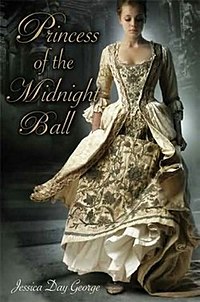
Princess of the Midnight Ball by Jessica Day George


Genre: Fantasy
Rating: *****
Pages: 280
Series: One companion novel, Princess of Glass, with a third, Princess of the Silver Wood, on the way.
When the kingdom of Westfalin finally declares victory on Analousia after twelve years of war, Galen has no home to return to. Luckily, the eighteen year old soldier is able to find work with his irritable uncle, keeper of the Queen's Garden. He soon falls in love with King Gregor's eldest daughter. But Rose and her eleven sisters are cursed. Every third night, the princesses disappear and wear out holes in their dancing slippers. None of the princes King Gregor recruits can solve the mystery.
Can a lowly under-gardener triumph where so many princes have failed? Galen is prepared to find out, armed with nothing more than his soldier's stamina and true love. Well, that and an invisibility cloak, herbs to ward of evil, his trusty knitting needles, two pistols, a rifle, and a penknife. Soldiers are supposed to carry weapons, after all. But let's just leave off at true love.
This is my third reading and I still can't figure out why it's so good. I think it must be Galen. Don't let the title and Ballgown Babe fool you. This isn't a girly book. It's told from both Rose and Galen's perspectives but focuses mostly on him. I love Galen. He's a respectful soldier boy when he needs to be, stands his ground when it's important to him, and turns into a cocky flirt whenever it suits him.
Princess of the Midnight Ball is an action packed, addicting read.

Saturday, October 13, 2012

Book Talk: A Word to YA Authors

All YA authors tour schools at some time. Many of them are former teachers. So why do they never understand how schools work?

1: Blackbords
I've never known a teenager who goes to a school that has them. We have whiteboards now, and sometimes SMART boards. Those are going to gain popularity in years to come.
2: Popularity ladder
Schools contain hundreds, some thousands, of students. Do you really think we'd take the time to rank every last soul by popularity? There's your friends, the people you know, and then everybody you don't know. Some people are more well known than others. Mostly for being stupid. Nobody memorizes the names, faces, and reputations of the entire varsity football team for the sole purpose of whispering about them. You're not going to track everybody by where they sit at lunch. You're too busy eating and talking to your own friends. Which brings me to our next item.
3. Cafeterias
Lunchrooms are big. And loud. Sometimes you have to ask a friend sitting next to you to repeat what they just said. So naturally enough, you won't be able to hear an anouncement over the intercom. You won't see somebody trip halfway across the cafeteria. And depending on the size of your school, you won't be able to sit alone at a table. You couldn't at my elementary or middle school, but my high school has more space because it lets people eat outside or in the halls.
My elementary school had twenty tables in two straight rows. Stand in the middle and you can see anything that goes on. There was an end of school food fight every year. I never saw it. Everything fifteen feet away goes unnoticed.
4: Characters dramatically switching seats after a dramatic breakup
Some teachers let you choose where you sit, but even they won't let you trade haflway through the quarter. Usually you get alphabetical seating at the beginning of the term and a more randomized seating chart once they've realized who's going to be their problem student.
Attention...students, I have a...very shrill announcement...to deliver...
5: P.A. systems
What does that even stand for, principal audio? I've always called it an intercom.
6: School nurses
Schools don't have their own anymore. Most nurses travel around between dozens of schools. When you get sick, it's the attendance office lady who opens the door for you and tells you to lie down.
7: Clever abbreviatons
Perhaps some people refer to their cafeterias as "the caf" and classes as "bio" or "chem". But to the rest of us, it just looks weird. English lit, home ec, gym when it was called lifetime fitness on your schedule, those are okay. But do yourself a favor and make it mainstream.
8. We're all sixteen going on seventeen
Except for the readers. I've been reading books about high school students since I was in third grade. Apparently ninth grade protagonists are only acceptable in boarding schools where they're not quite the youngest. Sixteen is the golden age. It's when you discover you're descended from a line of magicians and inherit your powers. It's the year the monsters realize you are the Chosen One and hunt you down. It's the year the prophecy must be fulfilled. It's the year you obtain a driver's license, so the setting isn't limited to the walking distance of Freshman Fred's stubby legs.
All the little people can read up. Unless they're content with the books featuring protagonists their age. Namely stupid middle school clique novels and fantasy where fifteen year olds don't need to be in school. Really, that's all there is. If they start out fifteen, they have a birthday by the end.

9. Miss Wilma Wallflower
She lurks on the outskirts of the aforementioned cafeteria, hiding behind her book, glasses, and long, dark hair. An outsider among blondies doting on lip gloss and boys. All the others find it strange that she reads and pulls straight A's. So she's supposed to be different.
But she isn't. She's a more common stock character than the blonde cheerleader. When female authors want to set a story in high school, they recall their own memories of teenage life, and this is what they get. But wait, there's more!
Despite his status as school quarterback and the personal harem clinging to him as he glides from one class to another, Dreamboy wants her. Because she doesn't want him. Because she doesn't wear makeup. Because she's intelligent. Bonus points if he's a senior and she's merely sixteen (see above). Wish fulfillment, anybody?
Oh, and intelligence? It's not that rare a quality in teenagers. But nobody gets straight A's unless they spend every single waking hour outside of school on homework. Minimal sleeping. No hobbies. No friends. Have fun writing a novel about Wilma spending a year in front of a computer screen maintaing her perfect report card.
Really, can't she settle for being an honor student? There's nothing wrong with a 3.0. How does the entire student body know her GPA anyways?
10. Mrs. McTeacher
From kindergarten to tenth grade, I have had...let's see...twenty-seven female teachers. Ms. Darger became Mrs. Johnson halfway through the year. Mrs. Mackerell had us call her just that. My Spanish teacher, Ms. Denney, encouraged us to call her Senora. Ms. Von der lohe taught theater and appreciated the title 'Queen V'.  All the rest had Ms. in front of their names. Even if they were old. Even if they were visibly pregnant for much of the year. Even if they had children attending the school. Even if they taught home ec. That's just how teachers work in the early twenty-first century. Until seventh grade, I didn't even know Ms was supposed to have an air of unconventional feminism to it. I thought it was an abbreviation for Miss. In books, Mrs. McTeachers strike me as weird unless they're supposed to be motherly, or grandmotherly, or evil teachers pretending to be caring for appearance's sake.

That's school as I know it. Time to break the tropes.